

1. What is a Trolleys/Forklifts Wheel Cleaning System?
A Forklift Wheel Cleaning System (also called Tire Cleaning Module or Tire Scrubber) is an automated device installed at passageways or transfer areas, specifically designed to clean the tires of industrial vehicles (such as forklifts, AGVs, and manual trolley) passing over its surface, preventing mud, dust, and oil contaminants from entering high-cleanliness zones.
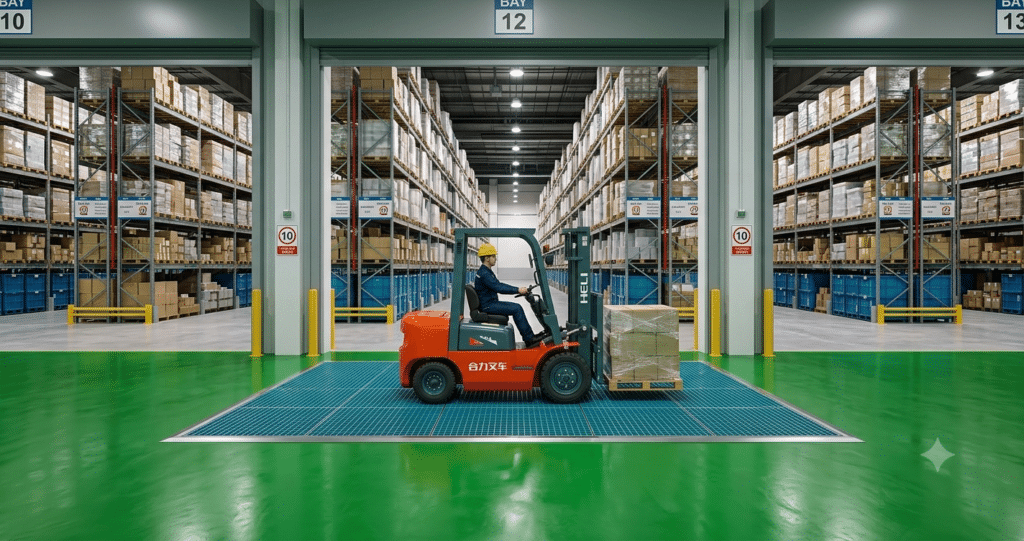
Two main types:
Dry cleaning modules-require no water or electricity, relying entirely on mechanical bristles to physically remove dust and particles. Ideal for dry environments or areas without utility connections. Maintenance is minimal – just periodic tray emptying.
Wet cleaning modules-use water or disinfectant solutions for high-hygiene environments such as food, pharmaceutical, and healthcare facilities. They provide a deeper clean but require regular fluid replacement.
2. How Does the Wheel Cleaning System Work?
Before understanding how the wheel cleaning module works, let’s first take a look at its composition.
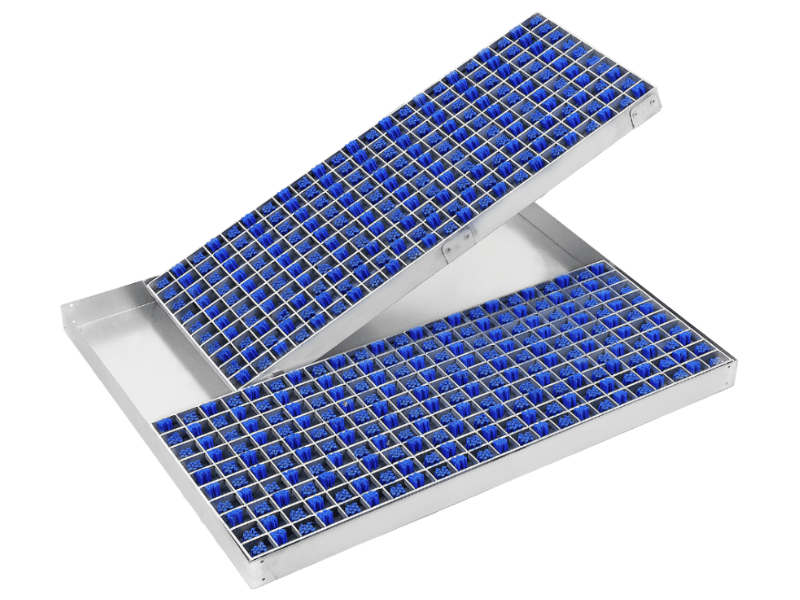
Wheel Cleaning System composition includes: Brush strips (bristle modules) + Load-bearing grating + Collection tray (dust pan).
Dimensions are approximately 900mm (L) x 739mm (W) x 53mm (H). The main body is usually made of 304 stainless steel, offering excellent corrosion resistance and durability.
So, how do these components work together as a system?
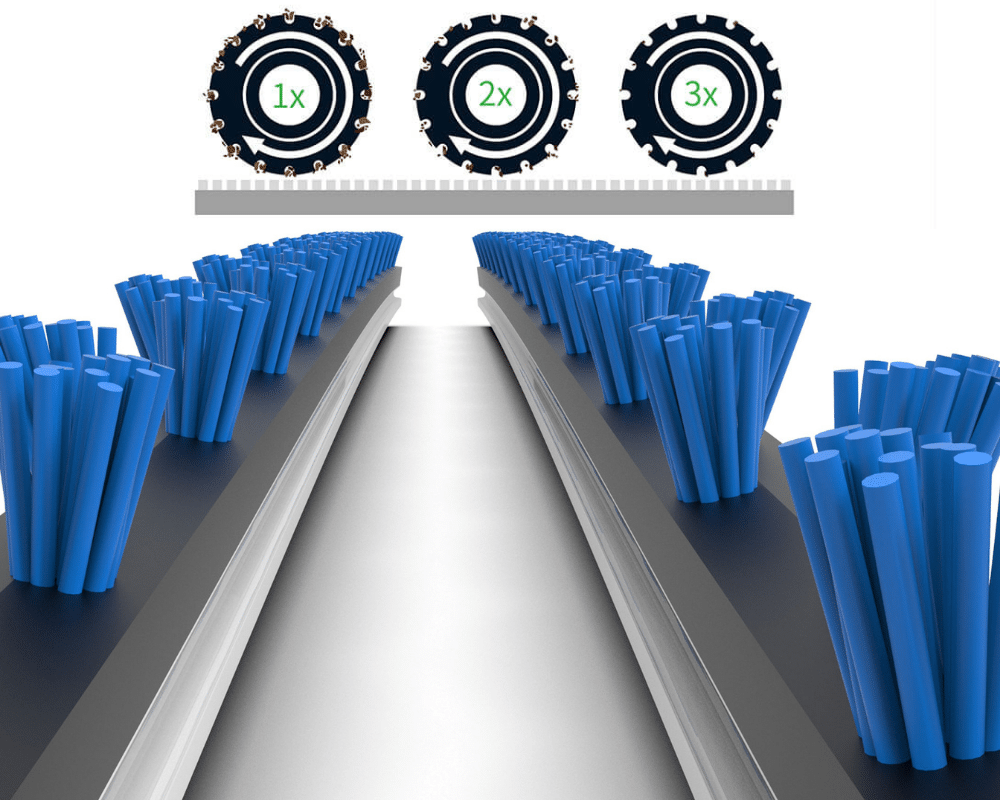
When a forklift or hand truck tire rolls over the module, the tire comes into contact with specially angled brush bristles. Under the pressure of the tire and the forward momentum of the vehicle, the bristles produce reciprocating vertical and horizontal oscillations. Through physical friction, dust, mud, and particles are “scraped” off the tire surface. The dislodged contaminants fall naturally into the bottom collection tray, which is emptied periodically.
Technical Highlights:
No external power needed:Purely mechanical design, requiring no electricity or water supply.
Brush design: Made of high-elasticity nylon filaments with an interlaced structure. When tires pass over, the bristles automatically oscillate and scrub.
Cleaning efficiency: Vehicles driving over the cleaning area for 3+ cycles can remove up to 95% of dirt; a single pass removes particles of 40–100μm.
Load capacity: Maximum load-bearing capacity reaches up to 3 tons, suitable for various industrial vehicles.
3. Why Your Faclity Need a Wheel Cleaning System?
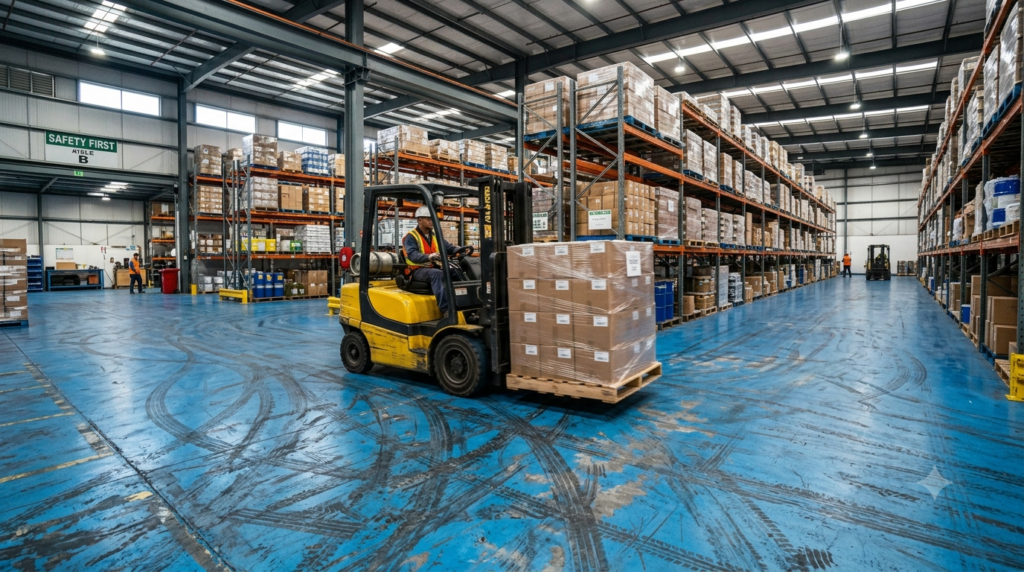
Many facility managers ask: “We’re already mopping the floors – why do we need a dedicated tire cleaning device?” The answer is simple: Because floor cleaning ≠ source control. By the time dust has been carried deep into your workshop by wheels, contamination has already spread.
The core value of a wheel cleaning module lies in intercepting contamination at the source, rather than cleaning up after the fact. Here are four key reasons why your facility needs this system:
3.1 Block Cross-Contamination at the Source
Forklifts and hand trucks travel between different zones every day – from loading docks to warehouses, from logistics corridors to production workshops, and sometimes directly from outdoors into cleanrooms. Tires act like “moving mops,” continuously carrying mud, dust, oil, and even microorganisms from non-clean areas into high-cleanliness zones.
The wheel cleaning module is installed at the boundary between clean and non-clean areas (e.g., workshop entrances, buffer zones, in front of air showers). As vehicles pass over, contaminants are automatically removed from tire surfaces, physically cutting off the path of contamination. Keep dirt outside the entrance – not scattered across your workshop floor.
3.2 Significantly Reduce Manual Cleaning Costs
Traditional workshop cleaning relies on manual mopping, sweeping, or scrubber machines. This approach comes with two clear costs: high-frequency labor input and production line downtime. Many factories need to assign dedicated staff to mop several times a day – especially during rainy seasons or peak logistics periods, cleaning crews are practically run ragged. Let’s do a simple cost comparison:
| Comparison | Manual Mopping | Wheel Cleaning System |
| Time per session | 15–30 min (requires downtime) | 0 sec (cleaning happens as vehicles pass) |
| Daily frequency | 3–6 times | Continuous |
| Annual labor cost | High (multiple staff × many hours) | Very low (only periodic tray emptying) |
| Production impact | Yes (requires pauses or detours) | No (seamless pass-through) |
In the long run, the investment in a wheel cleaning module is often far less than a single year’s worth of manual mopping expenses. It saves not just money, but also precious time and production capacity.
3.3 Extend Floor Coating & Surface Life
Epoxy floors, polyurethane floors, and sealed concrete floors are major assets for any factory – often costing over a hundred yuan per square meter. However, hard particles (such as sand, gravel, and metal chips) carried by forklift tires act like sandpaper, constantly grinding between the tire and the floor surface, scratching and wearing it down day after day.
Once the floor is scratched or damaged, it not only affects aesthetics and cleanliness but also harbors more dirt, creating a vicious cycle. Floor restoration is extremely costly and requires extensive downtime.
The wheel cleaning module removes these hard particles and collects them in the tray before tires ever touch your floor. Protecting your floor means protecting your fixed asset investment.
3.4 Help Your Business Pass Stringent Industry Certifications
In food processing, pharmaceuticals, precision electronics, medical devices, and similar industries, cleanliness is not an option – it’s a mandatory certifications.
| Industry | Relevant Standards | Requirement for Dust/Particles |
| Food Processing | HACCP、BRC、FSSC 22000 | Prevent physical contamination, control foreign body risks |
| Pharmaceuticals | GMP (Good Manufacturing Practice) | Controlled airborne particle concentration, strict clean zone partitioning |
| Precision Electronics | ISO 14644、IATF 16949 | Micro-dust affects yield; particle sources must be controlled |
| Medical Devices | ISO 13485、FDA 21 CFR Part 820 | Environmental cleanliness directly impacts product safety |
When auditors visit your workshop, the first thing they see is the level of control at the entrance – if you can’t even control contamination brought in by wheels, how can you prove that your production environment meets the standards? A wheel cleaning module is the most tangible evidence you can show auditors that “we take contamination control seriously.”
The wheel cleaning module is not a “nice-to-have” accessory – it is a critical investment that connects cost control, asset protection, and compliance certification – three core business priorities.
4. How to Select a Wheel Cleaning System?
Selecting the appropriate system requires a technical assessment across five core dimensions: contaminant profile, fleet specifications, material integrity, installation constraints, and total cost of ownership (TCO).
4.1 Contaminant Type & Cleanliness Grade
Define the primary contaminant and the required endpoint cleanliness:
- Dry particulates (dust, sand, debris) → Dry‑type modules (mechanical brushing, zero utilities).
- Oily residues / mud → Wet‑type modules (water or detergent injection).
- Biological risks (food/pharma) → Wet modules with disinfectant dosing capability.
Map this to your industry standard: GMP (Pharma), ISO 14644 (Electronics/Cleanrooms), or HACCP (Food). Higher grades demand finer particle removal (<40μm) and validated cleaning cycles.
4.2 Vehicle Fleet Parameters
Match the module’s physical specifications to your actual rolling stock:
- Tyre diameter: Standard modules accommodate ≤500 mm. Larger diameters require extended cleaning lengths to complete sufficient rotations.
- Tread width: Minimum requirement is typically 24–30 mm. Narrower wheels reduce bristle contact area and compromise efficiency.
- Maximum axle / vehicle weight (critical): Overloading causes permanent frame deformation and bristle failure.
| Load Class | Capacity | Application |
| Standard | Up to 3 tons | Forklifts, AGVs, pallet jacks |
| Heavy-duty | Up to 10 tons | Large counterbalance forklifts |
| Extra-heavy | 30–40 tons | Specialised industrial equipment |
Always verify that the rated capacity exceeds your heaviest fully loaded vehicle by a minimum safety margin of 15–20%.
4.3 Materials & Construction Quality
Longevity and effectiveness depend entirely on material selection:
- Frame: 304 stainless steel is mandatory for corrosive or wet environments. Carbon steel alternatives will oxidise and fail prematurely.
- Bristles: Specify PA66 (Nylon 66) with proven fatigue resistance. Premium bristles retain geometry for >100,000 passes and achieve a total service life of up to 500,000 passes.
- Modularity: Prefer systems with replaceable brush cartridges/strips. This allows localised replacement of worn sections without discarding the entire stainless-steel frame, drastically reducing long-term maintenance costs.
4.4 Installation Conditions & Layout
Installation directly impacts project lead time and cleaning efficacy:
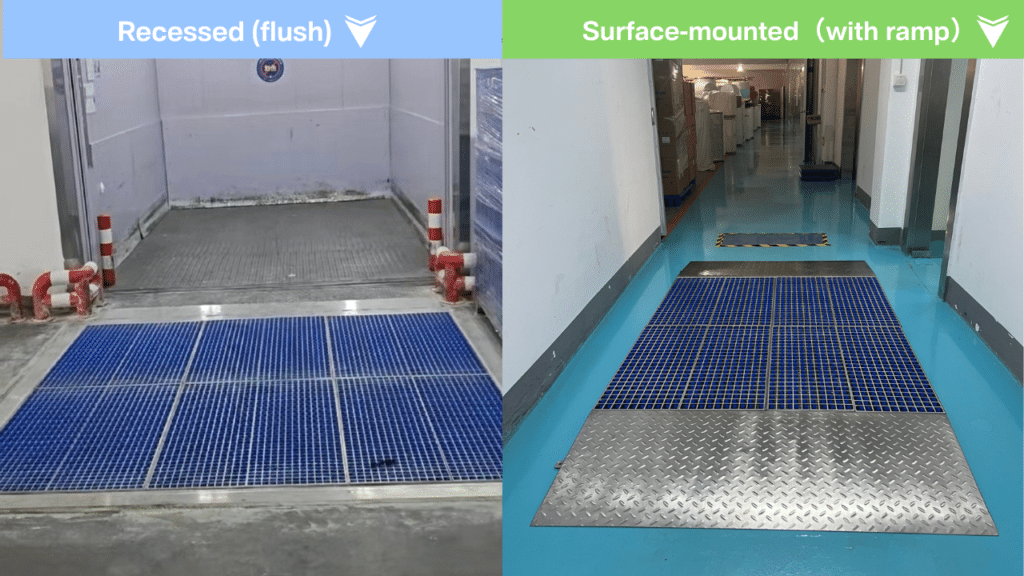
- Mounting type:
- Surface‑mounted – zero construction, portable, but requires transition ramps (height differential).
- Recessed (flush) – aesthetically integrated, no trip hazard, but requires floor cutting and levelling (±5 mm tolerance). Suitable only for scheduled shutdowns or new builds.
- Cleaning length: The system must be installed in series. A minimum of 4 consecutive modules (approx. 3.6 metres) is recommended to ensure 3–4 full tyre revolutions, achieving the advertised >95% removal rate. Shorter runs yield only partial tread cleaning.
- Floor condition: The substrate must be flat, load‑bearing, and free of major cracks or undulations.
 EN
EN  ES
ES  FR
FR  DE
DE  TR
TR  IT
IT  PL
PL  RU
RU  PT
PT  ZH
ZH  JA
JA  AR
AR